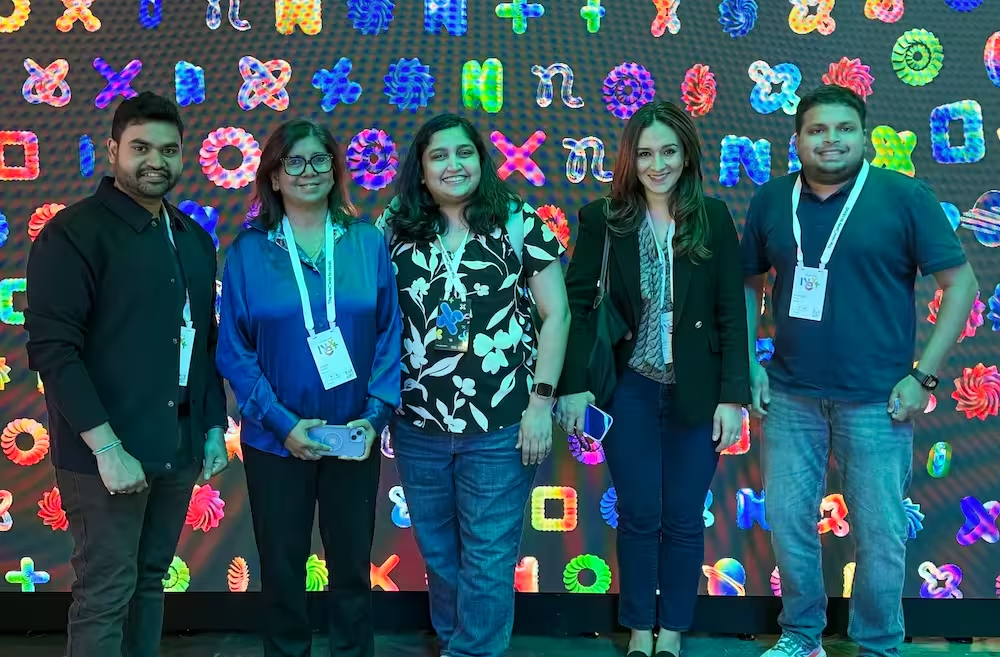
Relanto at Google Cloud Next ‘26: The New Blueprint for Enterprise Intelligence


AI Summary


The Agentic Enterprise Is No Longer a Vision, It's Infrastructure
Google positioned agentic AI as core enterprise infrastructure rather than an application layer. The announcements around the Gemini Enterprise Agent Platform signal a consolidation of development, deployment, and governance into a single unified layer, the kind of enterprise-grade scaffolding that organizations need before they can responsibly scale intelligent automation.
With low-code, trigger-based workflows integrated into the platform, organizations can now design and deploy agents without deep technical dependency. This shifts AI from centralized engineering teams to distributed business ownership, accelerating adoption across functions.
Six Strategic Signals from Google Cloud Next ‘26
1. Gemini Enterprise & No Code Agent Development
One of the most significant announcements was the maturation of the Gemini Enterprise Agent Platform into a foundational layer for building and operating enterprise-grade agents.
Its real impact lies not just in model capability, but in architecture. Google has unified agent development, deployment, monitoring, and governance into a single platform, reducing the fragmentation that has historically slowed enterprise AI adoption.
With low-code tooling and trigger-based workflow design, business users across operations, finance, HR, and customer success can now actively participate in building automation, without depending entirely on engineering teams.
This fundamentally shifts agent development from a centralized technical function to a distributed enterprise capability.
2. Seamless Multi-Cloud Intelligence
For most enterprises, multi-cloud is already reality, not strategy. Data spans AWS, Azure, and Google Cloud, often with fragmented access patterns.
Agents can now operate seamlessly across cloud environments, accessing and executing tasks wherever data resides.
This removes one of the biggest blockers in scaling agentic AI: brittle integration layers. Instead of stitching systems together, agents can now operate across the enterprise data landscape as a unified execution layer.
3. Open, Interoperable Agent Ecosystems via MCP
The introduction of the Model Context Protocol (MCP) signals a clear shift toward open agent ecosystems rather than platform-bound intelligence.
MCP provides a standardized interface for agents to discover, authenticate, and interact with external services and data sources, regardless of the framework they are built on.
This enables cross-platform interoperability across ecosystems such as LangChain, Claude-based systems, and Microsoft Copilot stacks, allowing them to integrate consistently with Google Cloud services.
For enterprises, this reduces vendor lock-in and enables modular AI architectures where best-of-breed tools can coexist and interoperate.
4. Collaborative Agent Orchestration with A2A
Agent-to-Agent (A2A) orchestration redefines how enterprise workflows are executed by enabling agents to collaborate rather than operate in isolation.
Instead of isolated agents performing discrete tasks, agents can now collaborate, delegate subtasks, and coordinate execution across multi-step workflows, combining generative reasoning with deterministic processes.
For example, a compliance agent can detect anomalies, trigger an audit agent for deeper analysis, and simultaneously query a regulatory intelligence agent, before synthesizing a final output.
This moves enterprise AI from task automation to process orchestration, making it viable for mission-critical domains such as compliance, risk, and financial controls.
5. Built-in Governance with Agent Gateway
As agent ecosystems scale, governance becomes a core architectural requirement rather than a post-deployment layer.
The Agent Gateway introduces a centralized control plane that governs agent behavior in real time. It enforces policies, restricts tool usage, and protects against risks such as prompt injection and sensitive data exposure.
Governance is no longer implemented per agent; it is enforced uniformly across the entire ecosystem.
For regulated industries, this becomes a prerequisite for scaling AI beyond controlled pilots.
6. Observability & Trust at Scale
If governance defines what agents are allowed to do, observability defines what they actually did.
With standardized telemetry and built-in monitoring, enterprises gain end-to-end visibility into agent execution paths, including tool calls, decision points, and data interactions. This enables auditability, supports compliance validation, and ensures operational transparency at scale.
More importantly, it builds trust. Without observability, agents remain black boxes. With it, enterprises can safely extend autonomy while maintaining accountability and control.

Relanto's Perspective: Aligned by Design
What resonated most from Google Cloud Next '26 wasn't any single announcement, it was the overall direction. The industry is converging on an architecture where AI is orchestrative, auditable, and deeply embedded into business workflows. That's precisely the philosophy behind how we build at Relanto.
With R-SmartAssist, our GenAI-powered enterprise framework, we enable organizations to design context-aware, multi-step intelligent assistants that integrate across enterprise systems, reason over real-time data, and drive actionable outcomes, not just recommendations. The framework is built to operate within the kind of governance and observability structures that Google is now standardizing at the platform level.
When you combine R-SmartAssist's capabilities with platforms like Gemini Enterprise, the result is a powerful foundation for scalable, secure, and genuinely intelligent enterprise automation, one that doesn't require organizations to choose between innovation and accountability.
What This Means for Enterprises Right Now
Google Cloud Next '26 wasn't a window into a distant future. It was a roadmap for decisions that enterprises need to make now.
The organizations that will lead in the next wave of AI adoption are those that move beyond isolated AI experiments and begin building the orchestration infrastructure, the governance layers, the observability pipelines, the cross-system integrations, that make agentic AI viable at enterprise scale.
The tools are here and the platforms are maturing. The question is whether your organization is building for where AI is going, or still catching up to where it's been.
The question is no longer whether enterprises will adopt agentic AI, but how quickly they can redesign their operating model around it.