




The arrival of Sales 3.0 and Software 3.0 has created a convergence moment redefining what’s possible for sales effectiveness, revenue predictability, and customer experience. In our executive summary, The 3.0 Convergence: Why Software and Sales Are Evolving Together—And What It Means for Enterprise Revenue Operations, we established that Sales 3.0 represent agentic processes that guide, augment, and automate the journey from planning through execution, while Software 3.0 delivers autonomous agents capable of orchestrating intricate workflows across systems. This article moves from foundation to impact, showing how convergence transforms critical revenue processes for Sales, Finance, and Marketing.
Convergence unlocks three fundamental capabilities:
- Business autonomy. Revenue teams, sales planners, and AI generalists build and refine solutions using natural language and low-code platforms in partnership with IT.
- Speed with reduced risk. Organizations prove value through rapid prototyping – 12-week cycles that validate assumptions before major investment.
- Cross-system Orchestration. Agents work across planning platforms, revenue systems, and customer data, translating events in one system into appropriate actions in others. Automatically
The result: substantially higher productivity for the humans these systems serve. Let's examine what convergence enables in practice and what it takes to get there.
.gif)
What Convergence Enables
We'll examine three transformation stories through the perspective of the executive owner: Sales, Finance, and Marketing. Each reveal both the executive outcome and the technical enablers that make it real.
Redefining Sales
The opportunity for the Sales leader is moving from low-leverage selling environments to high-leverage ones. High leverage means human effort concentrates where it creates the most value: strategic decisions and customer relationships.
Redefining Revenue
For Finance leaders, the opportunity is moving from reconciling competing numbers to orchestrating leadership decisions as forecast, capacity plans, and investment decisions align continuously.
Redefining the Customer Journey
For Marketing leaders, the opportunity is directing growth based on proven revenue impact, moving on from defending budget based on activity metrics. Marketing sees with precision how engagement converts to pipeline and pipeline converts to revenue.
The transformation stories share common requirements. Unlocking convergence capabilities demands the same deliberate work: deploying 3.0 technologies, renewing processes for human-agent collaboration, and establishing governance frameworks designed for autonomous agents working across systems.
What Convergence Requires
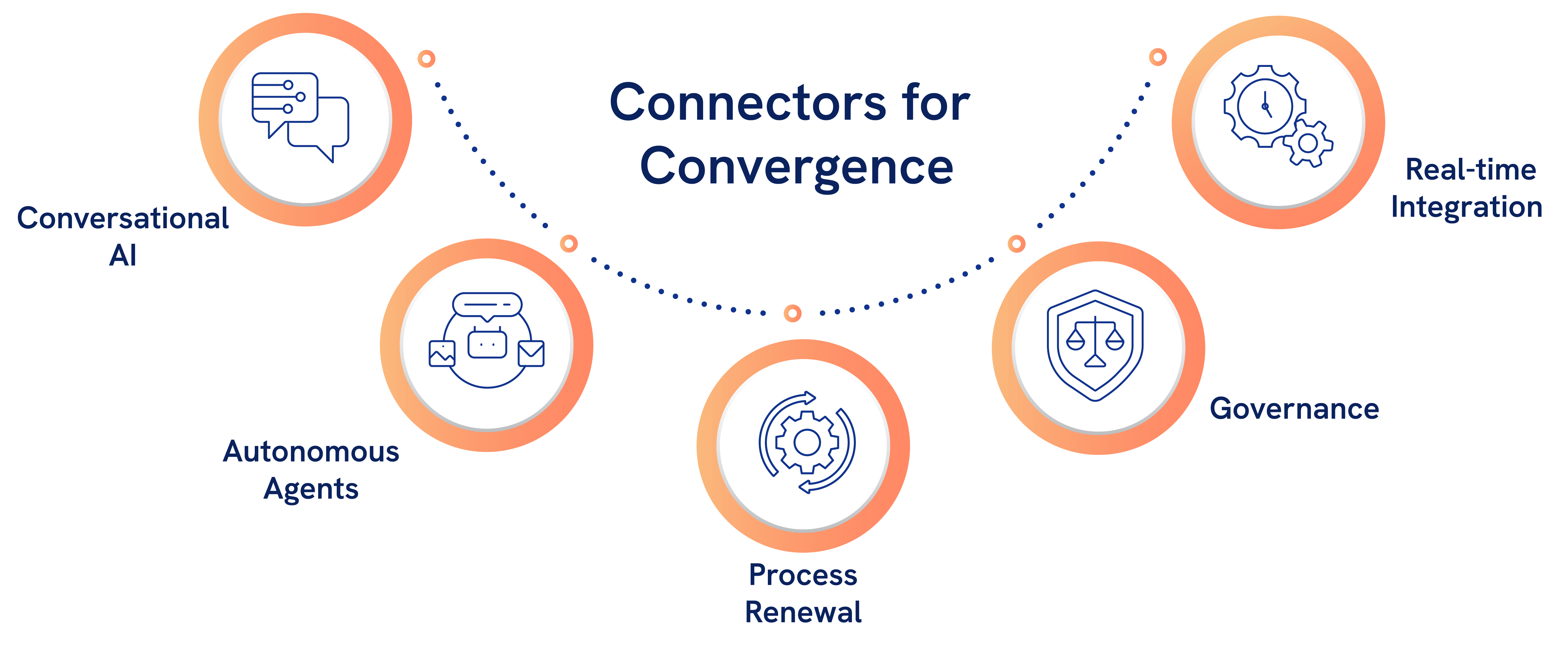
The 3.0 technologies – conversational AI, autonomous agents, real-time integration – enable the transformation above. Two additional requirements determine whether convergence delivers or disappoints: process renewal and governance.
Process renewal for humans + agents
Process renewal means redesigning workflows for a fundamentally different operating model. You're not automating what humans do today. You're designing how humans and agents work together when continuous analysis replaces periodic reporting.
The sales manager reviews AI-synthesized insights and decides where to coach. The financial planner validates that autonomous agents apply the right business logic as they orchestrate across systems. The marketing analyst interprets patterns agents surface across the customer journey.
This requires different thinking. What decisions do humans make that agents should inform? What actions can agents take autonomously versus what requires human judgment? Where do humans add unique value that AI can't replicate?
Governance that enables rather than constrains
When agents make decisions and trigger actions across critical revenue processes, governance becomes more important, not less. You need clear frameworks defining what agents can do autonomously, what requires human approval, and how to audit their reasoning.
This isn't about constraining AI; it's about enabling it safely at scale. Strong governance lets you move faster because teams trust the agents working on their behalf. Weak governance forces teams to double-check everything, eliminating the productivity gains convergence promises.
What does this look like in practice? Organizations getting this right establish clear autonomy tiers: what agents can do independently, what requires human approval, and what requires human decision-making. They implement targeted guardrails for financial exposure, data access, and auditability. These boundaries make AI safer to trust and faster to deploy.
hey also define governance alongside their convergence architecture, not as an afterthought. They build transparency into agent reasoning – executives can audit why an agent recommended shifting forecast assumptions or reallocating budget. They establish clear accountability for outcomes and create feedback loops that improve agent performance over time.
Staying connected to the evolving technologies
Convergence requires hands-on knowledge of where these technologies excel and break – such as, where agent orchestration breaks, where integration patterns fail, and where low-code hits limits. The challenge is gaining that visibility without disrupting production systems or resourcing dedicated research teams.
Our AI-First Lab has this as a core mandate. The team tests the capabilities and limitations of enterprise planning platforms, revenue execution systems, and the AI, data, and cloud infrastructure that connects them. We explore what autonomous agents can orchestrate reliably, where low-code platforms hit boundaries, which integration patterns scale and which create new bottlenecks. We host academics and industry leaders, embedding their knowledge and questions into our research.
The hands-on research, combined with conversations across our client base, reveals patterns in what actually works. From this knowledge, we've built system-agnostic accelerators –purpose-built connectors reusable across platforms. These accelerators keep your planning, revenue, and customer systems talking the same business language while agents orchestrate across them.
For enterprises with the capability, building your own accelerators may make sense. What matters is having connectors designed for convergence rather than hoping vendor-specific agents will eventually talk to each other.
What's Next
The opportunity is clear. Convergence transforms how revenue operations function when organizations architect for it deliberately. The recipe: 3.0 technologies, renewed processes, governance frameworks, and cross-system orchestration.
Two questions worth examining: Where is your organization getting stuck between aspiration and reality? And how do you prove convergence will work for your specific processes before major investment?
Our next articles explore both. We'll share a readiness conversation, helping you identify which friction points to address first and what architectural foundations enable convergence. Then we'll examine rapid prototyping approaches that validate assumptions in 12-week cycles – proving value before you scale.
This is a conversation worth having – with your executive peers, with your board, with partners who understand both the business process challenges and the technology architecture required. We welcome the dialogue.
